
TALK · PROW 2026 · TIMIȘOARA
Everyone can build. Almost nobody stops.
When everyone can build, stopping is the new building, and trust is what makes it possible. This is the talk, chapter by chapter.
CONSUELA NICULA · CEO & FOUNDER, NOLUM · 25 MIN
01 · THE SHIFT
Building got 280× cheaper.
Value didn't move.
For the first time in history, building is almost free. In 2022, running a model as capable as the first ChatGPT cost about $20 per million tokens. Two years later: 7 cents. Meanwhile only 37% of companies see any profit impact from AI, and that number hasn't moved.
COST TO BUILD WITH AI
$20 → $0.07
2022 to 2024
COMPANIES SEEING PROFIT FROM AI
37%
Last year and this year. Flat.
The constraint didn't disappear. It moved.
Build
USED TO BE THE BOTTLENECK
→
Decide
IS THE BOTTLENECK NOW
We can now ship the wrong thing just as fast as the right thing. Same speed, same effort, same celebration at launch. Google's DORA research calls AI an amplifier: it magnifies good teams and struggling ones. Gartner expects more than 40% of agentic AI projects to be cancelled by the end of 2027. So everyone stops eventually. The only question is how early, and how cheaply.
02 · THE TRAP
More features. More growth. More… of what?
We live in a world that rewards more. Pendo measures how people use software across more than 6,800 products. In the average product, 6% of features get 80% of all clicks. Every unused feature is a team's time and talent spent on something that barely matters.
I'm not against growth. I'm against growth that confuses activity with value.
Speed without judgement is just faster waste.
03 · WHY NOBODY STOPS
Someone has to say it out loud.
We have the data and the dashboards, and usually someone already knows. But stopping means someone has to say, in front of their manager or the client:
“This isn't working.”
And that takes courage & trust.
Google studied its own teams for years: the number one factor was psychological safety. So where does that come from? A formula from The Trusted Advisor:
Trust =
Credibility
+
Reliability
+
Intimacy
Self-orientation
The more it's about me, the less trust there is to go around. When leaders make it about protecting themselves, teams stop taking risks. When teams make it about looking good, they stop telling the truth about what didn't work.
↓ Self-orientation
It's not about my idea, my bonus, my image.
↑ Empowerment
People get the room to decide and act.
✓ Safe to fail
Trying, failing and stopping stop being risky.
04 · SMALL BETS
One big bet, or many small ones?
You can't just announce that it's safe to fail now. People need to feel it, on something real, with low stakes. December 1903 shows two ways to learn.
Samuel Langley
Head of the Smithsonian, $50,000 of War Department money, one big machine. 7 October: into the Potomac. 8 December: into the river again.
The Wright brothers
A bicycle shop and hundreds of small glider tests. Nine days after Langley's second crash, they flew.
Every failure told them what to change.
1900
Not enough lift.
→ Enlarge the wing.
1901
Still not enough.
→ Build a wind tunnel.
1902
It won't turn.
→ Link the rudder.
14 DEC 1903
Stalled on launch.
→ Repair, and wait.
17 DECEMBER 1903
12 seconds. 120 feet.
Four years of small failures, and not one was a waste. They didn't win by building faster. They won by learning faster, and knowing when to stop, fix and try again.
Smithsonian National Air and Space Museum, Langley Aerodrome A · Photos: Library of Congress, Wright Brothers Negatives
05 · PRACTISE STOPPING
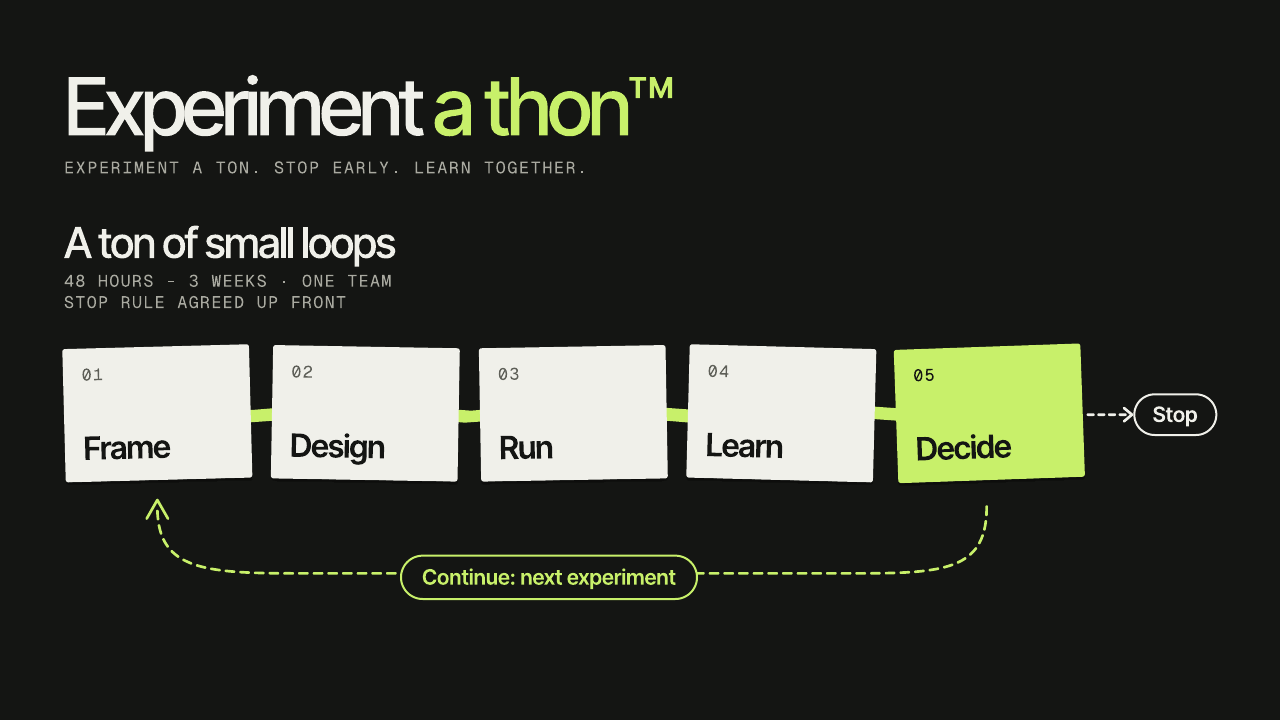
Experiment a thon™: a ton of small experiments.
Experiment… a… thon. Say it out loud and you hear it: experiment a ton. Stop early. Learn together. One team, one outcome, 48 hours to 3 weeks, and a stop rule agreed before you start, so a failed test is nobody's fault.
GOAL
25 years of data. Little time. High stakes.
A home valuation people can trust
ONE NUMBER
€1.5M revenue in 6 months
01 FRAME
Can AI price a home people trust?
02 DESIGN
9 small trials, a new variable each time
03 RUN
First results were off by 70%
04 LEARN
It priced a cheap street like a rich one
05 DECIDE
Stop chasing perfect. Ship small: one region, houses only.
×2 REVENUE SINCE
600,000+ USERS A DAY
The hardest decision was to stop chasing perfect. Shipping small is what let every later release build on the last.
06 · THE PAYOFF
Compound interest on what you know.
Every stop teaches
→
Learning compounds
→
Value compounds
Look at the valuation tool: nine trials, off by 70%, and for a while it looks flat. Then the team shipped small, one region and houses only. €1.5M in six months, revenue doubled since, and more than 600,000 people use it every day.
Every experiment you stop early is an unused feature you never have to build. You build less, and more of it matters. That's how you grow value without the limitless growth push.
On Monday:
before you build, agree when you'll stop. A state and a date. “If fewer than 100 people use this by the end of March, we stop.”
REMEMBER YOUR RAISED HANDS?
Next time you know halfway through, you'll have earned the right to stop.
Because you ran it small, you ran it together, and your team trusts each other enough to say: “this isn't working.” Fail small. Fail together. In a world where everyone can build, stopping is the new building.
TAKE IT HOME · FREE PDF · 1 PAGE
One page. Five steps.
The Experimentathon™ Canvas: leave the room with a decision nobody argues with afterwards, in 48 hours to 3 weeks, and a record your next decision starts from.
Free, no sign-up. Saw the talk at PROW 2026? You're welcome.
What value, for whom?
The outcome you're after, and whether it's worth it, scored for purpose and for profit.
One number that settles it
A primary metric with its baseline and targets, a few secondary metrics, and guardrails that must not drop.
Continue, change or stop
Agreed together before you run, tied to the primary metric. A stop is a result. Celebrate it.
RULES OF THE ROOM
No blame. Every guess welcome. Stopping is a win.
Sources
Stanford HAI (2025). AI Index 2025: State of AI in 10 Charts.
McKinsey (2026). The State of AI.
Gartner (25 June 2025). Gartner Predicts Over 40% of Agentic AI Projects Will Be Canceled by End of 2027.
Google Cloud (2025). Announcing the 2025 DORA report: State of AI-assisted Software Development.
Pendo. Product Benchmarks (2024 analysis, 6,800+ applications).
Pendo (2019). The 2019 Feature Adoption Report.
World Economic Forum (Dec 2015). Google's surprising discovery about effective teams (Project Aristotle).
Maister, D. H., Green, C. H. & Galford, R. M. (2000). The Trusted Advisor. Free Press.
Teller, A. (2016). The unexpected benefit of celebrating failure. TED.
Duke, A. (2022). Quit: The Power of Knowing When to Walk Away. Portfolio.
Smithsonian National Air and Space Museum. Langley Aerodrome A.
Photos: Library of Congress, Prints & Photographs Division, Wright Brothers Negatives.